The Woman at the Washington
Zoo - Topics for Discussion
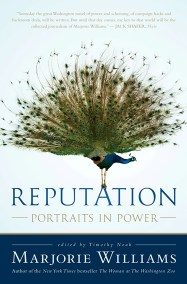
1. In the Introduction to the book Marjorie’s husband,
Timothy Noah, admits to subverting Randall Jarrell’s meaning by casting
Marjorie as “The Woman at the Washington Zoo.” How is Marjorie like
and unlike the woman of the poem’s title?
2. Also in the Introduction, Tim describes Marjorie’s “unrelenting
refusal to accept fraudulent surface reality and her remarkable skill at finding
the hidden truth that lay beneath.” How does this sensibility reveal itself
in her portrait of Richard Darman? Of Barbara Bush?
3. Marjorie’s subject matter evolves throughout the book—from
Washington personalities to marriage, family and illness and finally, to Marjorie
herself. How does your view of the author change as the book progresses?
4. In “Entomophobia” Marjorie defines the “physics
of motherhood” as the opposing forces of “maddening disorder, the
constant unexamined fear” on the one side, and the “blessedly equal
force of …wonder” on the other. How does this tension play out in
the last section of the book? How does it play out in your own life?
5. Marjorie argues that most American women foster the hope that
there is “An Answer” to the dilemma of work and family. But she accepts
that there is a fundamental, irresolvable tension in working motherhood, writing:
“guilt, I now think, is the tribute that autonomy pays to love.” Do
you agree?
6. In “The Alchemist” Marjorie paints a portrait
of her mother as self-denying. How is her mother also, to some extent, selfish?
How did Marjorie chose to live her life differently? How are these two life views
illustrated through their relationships with food?
7. In “Hit by Lightning” Marjorie describes the fury
and frustration of knowing that her time is finite, while at the same time acknowledging
that “the knowledge that time’s expenditure is important, that it
is up to you, is one of the headiest feelings you will ever feel.” What
does she mean by this?
8. Among the many of life’s tensions that Marjorie illuminates,
is the struggle between hope and realism—both within herself and embodied
in the roles she and Tim take on during her illness. Do you see these same roles
played out in your own family?
9. Marjorie writes, “Forced into a corner, I’ll choose
truth over hope any day.” Would you? She then adds, “But….my
body enacted some innate hope that I have learned is simply part of my being.”
Do you agree that hope lingers inside all of us on some unconscious level, no
matter how pessimistic we may try to be?
10. In “The Random Death of Our Sense of Ease” Marjorie
struggles with having to explain to her little boy that many events simply don’t
happen for a reason. Has there been an event in your life that made you feel that
“there is no logic at all to some of the worst blows that life metes out”?
11. Marjorie writes of having cancer, “You live life the
same, except with more pancakes.” Have you been in the situation of having
to live with a painful reality? If not, how do you think you would cope? How would
you explain it to your children?
12. Marjorie writes with remarkable candor of her friends’
sometimes ghastly reactions to her illness. Does reading her account change the
way you might understand or approach a friend experiencing grief or illness?
13. In “The Halloween of My Dreams” Marjorie writes,
“It made me hugely sad to see that my escapes from the taskmistress of literalism
are still so rare and hard-won.” What does she mean by this? Do you feel
you approach life as a realist or do you frequently indulge, as she does in this
final moment, in fantasy?