10
Questions with Timothy Noah
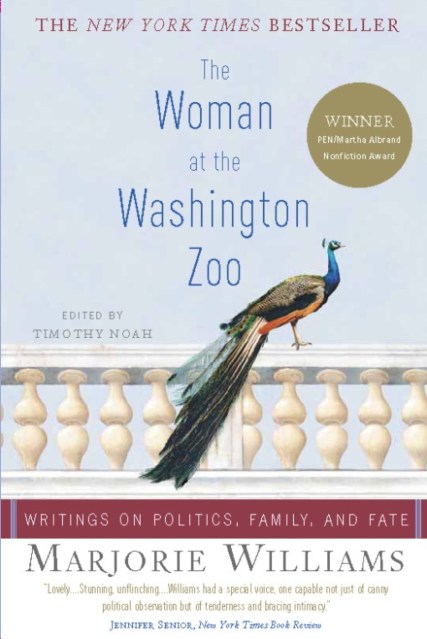
In the fall of 2005, PublicAffairs published THE WOMAN AT
THE WASHINGTON ZOO, a collection of the journalism of Marjorie
Williams, a Washington journalist who had died of cancer in January
of that same year.
Timothy Noah, her husband and a senior writer at the online journal
Slate, selected and edited the essays for this book. Carla Cohen
talked to Noah about the life and work of Marjorie Williams.
CC: When I read this book I felt like I had a
new friend in Marjorie Williams. I had read many of the pieces
over the years, but when they are assembled in one place, and
you read them at more or less the same time, you see the journalist
at least as clearly as the subjects. She must have been uncommonly
smart and clear-eyed to write such perceptive pieces.
TN: A number of journalists I know, people who
admired Marjorie and read her pieces when they came out, said
that only now, on rereading them, did they see how well-crafted
they were, and how much they expressed the sensibility of the
writer. In Washington, information tends to be skimmed—especially
political information. So I think the strong literary and personal
quality of her work wasn't fully appreciated until it was put
between hard covers. I've heard many people marvel at the intimate
quality of Marjorie's writing, even when she was writing on impersonal
topics.
CC: This book has been an unexpected success.
Public Affairs had to print more copies and the book is being
purchased throughout the country, not simply in Washington. Collected
nonfiction essays are generally a hard sell. Why do you think
The Woman at the Washington Zoo fared so well?
TN: Partly, I think, it reflects baby boomers'
newfound interest in the topic of mortality. It's been widely
noted that 2006 is the year the first baby boomers will turn 60.
Much of Marjorie's book is about the liver cancer that killed
her. Marjorie writes about her illness, consciously, from the
perspective of a cancer patient who wants to explain to a healthy
person, as concretely as possible, what it feels like to be dying.
I think the success of Joan Didion's new book, The Year of Magical
Thinking—whose sales apparently surpass anything Didion
wrote previously—also reflects baby boomers' interest in
death (in this instance from the perspective of one who is grieving).
Carole Radziwill's book, What Remains—which I haven't read—is
another book about grief that's been selling very well.
But that only partly explains the book's success, and it's a fairly
reductive explanation. I think readers are responding powerfully
to Marjorie's voice—to the vividness and the strong appeal
of Marjorie's personality. In the book's introduction, I invite
readers to experience "the intense pleasure of her company."
Marjorie was a very compelling person, and people enjoyed being
around her (unless, of course, she happened to be profiling them).
To a great extent, that aspect of her personality came through
in her writing, too.
CC: I don’t understand the relationship
between Marjorie and the woman in the Randall Jarrell poem that
gives the book its title. To me she seems as utterly different
from the Jarrell poem as anybody could be.
TN: Yes, she is quite different. In the book's
introduction, I apologize for subverting Jarrell's meaning. The
woman in Jarrell's poem is defeated, dehumanized, de-sexed; all
color has been drained from her. Marjorie was nothing like that;
her plumage couldn't have been more vivid. It was, however, convenient
for me to borrow the notion of a woman at a zoo, observing the
animals. In my construct, the woman is Marjorie, and the animals
are the various social types in Washington—"The Pragmatist,"
"The Philanthropist," "The Hack," etc., which
are all chapter titles in the book's first section. This has absolutely
nothing to do with Jarrell's use of these same elements.
My construct breaks down after the book's first section, but so
does the awkwardness of the book's relationship to the poem. In
parts two and three, the book's title gradually becomes more faithful
to Jarrell's meaning. Jarrell's poem is, after all, written in
the oppressed woman's voice; it's a hair-raising cry of protest
against the loss of vitality and autonomy. As Marjorie delves
deeper into her own story, we hear a similar cry. We see Marjorie's
anguish over her mother's loss of vitality in "The Alchemist,"
and, in the book's final section, we see Marjorie struggle to
maintain her own vitality as her body is failing her. The poem's
final lines are, "You know what I was,/ You see what I am:
change me, change me!" In this she is both successful and
not. As her illness progresses, Marjorie maintains her clear-eyed
perspective, and remains alive to life's possibilities. At the
same time, she reconciles herself to the inevitability of her
death.
I'll grant you it's not a perfect fit, and there's a limit to
my willingness to see my wife's death in literary terms at all.
In part, I'm just trying to follow her own lead. Marjorie herself
made use of the Jarrell poem in her tribute to the late journalist
Mary McGrory (which appears at the end of the book's second section).
Marjorie absolutely adored Jarrell. She was especially fond of
his comic novel, Pictures From An Institution.
CC: It would seem that Marjorie found a great
subject in Washington and its characters. Can you talk about Marjorie’s
feelings about her city?
TN: She liked Washington quite a lot; much preferred
it, for instance, to New York, which she moved from in the mid-1980s.
She liked its smaller scale. I guess it felt to her like a half-step
back toward Princeton, which is where she grew up, though she
never put it quite that way. I was paging through one of Marjorie's
childhood journals not long ago and, in a passage about visiting
Washington in early 1973 to protest the Vietnam war with her father,
she wrote about how beautiful she thought it was and said that
she'd like to live here someday. I'm sure she'd completely forgotten
writing that by the time she actually did move here, but maybe
some of the underlying feeling lingered.
Marjorie explains her feelings toward Washington at the end of
"Flying to L.A.," a chapter in the book's second section.
There was much in the place that she found conventional and conservative,
but she liked to write about the contrast between Washington's
constricted code of behavior and what she called "the messy
human stuff" that everyone pretended wasn't there.
CC: Will you tell us about how you selected the
pieces that you included? I particularly loved the profiles. Are
there some that you left out?
TN: I left quite a bit out. In my first cut,
I found that I had to limit Marjorie's many superb profiles of
powerful and ambitious white males—especially powerful and
ambitious white Republican males—because after you read
two or three, one after the other, they started to sound alike.
The blame, I think, lies not with Marjorie but with the white
males themselves. The profiles included in Zoo are very deliberately
diverse, not out of some politically-correct impulse so much as
the need to emphasize variety within the Washington bestiary—perhaps
a bit more variety, in truth, than exists in the real Washington.
I also left out profiles of people who were not obvious Washington
types. Michael Lewis, about whom Marjorie wrote a riveting profile
in Vanity Fair, didn't strike me as properly classifiable as a
Washington type even though he actually had lived in Washington
when the story was first published. Ditto, Larry King. Others,
like Anna Quindlan and Patricia Duff, weren't living in Washington
when Marjorie profiled them for Vanity Fair, so they didn't really
fit.
Even with this template for exclusion, the original manuscript
of Zoo was about twice as long as the book that was finally published.
I was particularly distressed to cut Marjorie's Washington Post
profile of Clark Clifford, which many people remember as her best,
from the book. It was just too long. The good news is that the
strong success of Zoo probably makes it inevitable that I will
publish a follow-up volume. When I do, Clifford will definitely
be included.
CC: I also thought that many of the articles
seemed fresh and relevant even after as many as 15 years. Did
you have that in mind as you chose the articles?
TN: To my mind, the pieces never stopped being
fresh and relevant because they read like short fiction. The key,
for me, was to choose pieces not on the basis of how important
the profile subject was, but on the basis of how well Marjorie
conveyed that person's psychology, and what the person's story
showed about the sort of place Washington ever shall remain. Some
people, I'll grant you, were so boring that I couldn't even bring
myself to reread Marjorie's profiles of them, much less include
their profiles in the book. Sam Skinner, who was chief of staff
to Bush 41, is an example. I figured that if I barely remembered
that Marjorie had profiled Skinner, then it couldn't have been
one for the ages. Maybe 20 years from now I'll take another look
and discover I made a terrible mistake.
CC: I don’t know many of the people that
are featured in Marjorie’s journalism, but I know Vernon
Jordan a little. Marjorie captures Vernon Jordon brilliantly –
I could not believe she did that piece 15 years ago. What did
he think of it?
TN: I don't think he much liked it, though I
don't recall the details; I heard about it third-hand. That one
was a little awkward for me because at the time Marjorie wrote
it Jordan sat on the board of directors of Dow Jones, which owned
the Wall Street Journal, for which I worked (I don't work there
anymore; now I work for Slate, which is owned by the Washington
Post Co.). Marjorie and I had sat with Jordan and his wife at
a Journal function not long before she wrote the piece. Of course,
that's one of the themes of Marjorie's profile—Jordan's
sheer ubiquity, which tends to silence anyone who wants to write
about his troubling transformation from civil rights leader to
corporate fat cat.
Jordan is among the most charming people I've ever met. Marjorie
was, among other things, a great connoisseur of charm and its
uses; she studied at the feet of a master (her father), as she
explains in the book. She puts this talent to great use in the
Jordan chapter.
CC: Marjorie clearly had a novelist’s eye
for character. Nowhere is this more evident than in her remarkable
dissection of her parents. It’s an extraordinary essay.
Some of the lines are so memorable. About her mother: “You
could eat at her table every night and never taste the thing that
you were really hungry for.” Did she think about writing
a novel?
TN: Yes. She started one, and left behind some
fiction-writing exercises, but she'd only made a few baby steps
in that direction when she died. I have no doubt that eventually
Marjorie would have written some very good fiction. At the same
time, I think the quality of Marjorie's best writing demonstrates
that the best nonfiction makes as strong a literary claim as the
best fiction. I think "The Alchemist," which is the
essay you refer to, is the best thing Marjorie ever wrote. There's
certainly more of Marjorie in it than there was in anything else
she put to paper.
CC: Finally, I had the feeling that most of the
pieces in this book could only have been written by a woman. They
represent a woman’s eye and sensibility. Of course, she
also writes about “women’s issues,” but I just
felt the power of her women’s voice throughout. Do you feel
that way?
TN: Yes. Jennifer Senior, in a wonderfully perceptive
review in the New York Times Book Review, made the same point,
but with some trepidation, as though she worried such a judgment
might appear to diminish Marjorie's work. I don't think it diminishes
Marjorie at all to say that she was a very distinctively female
writer. That was a term of praise Marjorie herself often used
to describe other people's work. Of course she thought much of
the stuff peddled as "chick lit" was hackwork. But many
of the women writers Marjorie most admired—Anne Tyler, say,
or Penelope Fitzgerald—she admired specifically for their
skill at conveying a woman's sensibility. Marjorie would be proud
to be thought so herself. Which, of course, doesn't mean her book
is just for women. If it were, I promise you, I'd have lost interest
before completing its assembly. It's just a wonderful book. I
can say that, you know, because I didn't write it!
© Politics and Prose Bookstore
Reading Book Guide
Back to top
|